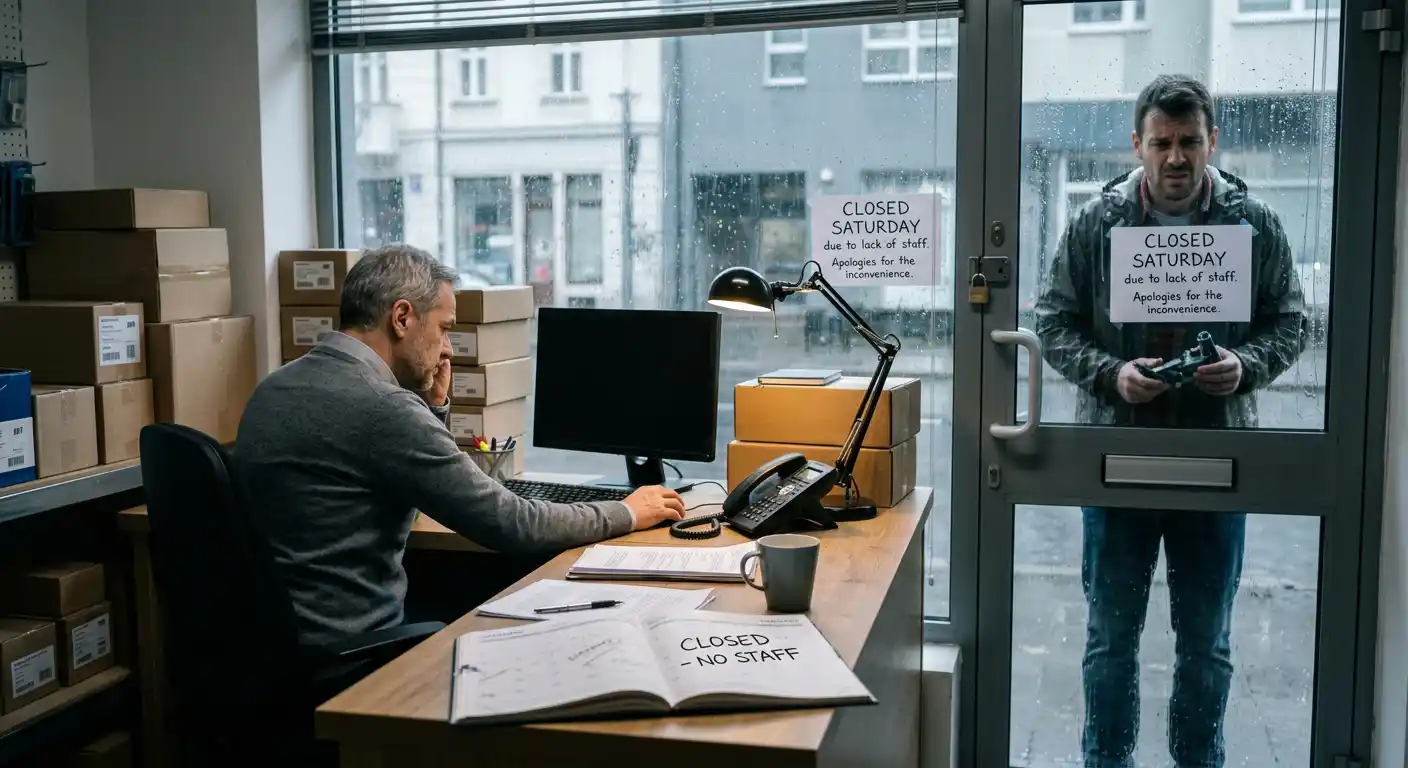

Ask a shift manager to describe their job and you'll hear about the floor, the team, and the customers. Ask how they actually spent last week, and a substantial share of it usually went to the schedule.
This work is rarely in the job description and almost never in the headcount plan. It shows up instead as evenings, as phone time on days off, and as the reason one-to-ones keep getting moved.
Why it's hard to see
Coverage work fragments in a way that hides its size. It isn't one long block of scheduling. It's a series of small interruptions:
- Reading and answering swap requests scattered through a chat thread.
- Working out whether a proposed trade leaves the shift properly staffed and compliant.
- Working down a list of names to fill a gap after a call-out.
- Re-publishing a schedule that has changed twice since it went out, and making sure everyone knows which version is current.
Each of these takes a few minutes. Collectively they can be one of the larger claims on a manager's week — and, because they're interrupt-driven, one of the most likely to spill past the end of a shift.
“Coverage work rarely appears as a block in the calendar. It appears as the reason everything else in the calendar moved.”
Why working harder doesn't resolve it
The instinctive fix is to get better at it — reply faster, tighten the rules, build a more elaborate spreadsheet. This tends to produce limited results, because the work isn't skill-limited. It's structure-limited.
A swap request that arrives in a chat has to be located, contextualised, and checked before it can be decided. The decision itself takes moments. Everything around it is overhead created by where the request landed — and personal discipline doesn't remove overhead of that kind.
What actually reduces the load
Two structural changes do most of the work, and neither depends on the manager behaving differently:
- [Let employees resolve coverage between themselves.](#swap-culture) If anyone eligible can claim an open shift, the manager stops acting as a switchboard and becomes an approver instead.
- Put the decision and its context in one place. When the request, the shift details, and the conflict check arrive together, approving a swap costs a tap rather than an investigation.
The manager still decides everything they decided before. What changes is that the assembly work in front of the decision — the finding, checking, and cross-referencing — largely goes away.
Where ShiftScout fits in
The schedule will keep changing. People get sick, plans shift, and availability changes.
The goal isn't to eliminate those changes. It's to make them easier to coordinate.
That's the problem ShiftScout is designed to address: helping bring shift changes, availability, and the relevant context closer to the shift itself, so less of the process depends on manual back-and-forth.
The manager still decides what they decided before. The difference is that the coordination leading up to that decision can be more structured.
Worth saying plainly
If you manage a shift-based team, the schedule is a real part of your job and deserves a real place in your week rather than the edges of it. Track the hours honestly for a fortnight and see what the number actually is for you.
If it turns out to be substantial, that isn't a personal failing to work harder at. It's a system worth changing.
I am an entrepreneur driven by innovation and real-world problem-solving. ShiftScout was inspired by my own experience of working shifts from an early age. I often wished there was a solution like ShiftScout to make finding and managing shifts easier. That personal experience became the foundation for building ShiftScout and turning a real challenge into a scalable business solution.